‘The Card Game’ using colored pencils
When I looked through this course I found Part 4 was clearly the most enjoyable for me. I was drawn to this subject due to my interest in the detailed observation of the human body. Also – even though most of the time I had no model – the variety, the endless possibilities inspired me to work much harder. From the start, I wanted to depict figure(s) and still life in the background. I really fancied the idea of cardplayers at that time since over Christmas I saw my relatives playing almost every evening. I tried quick 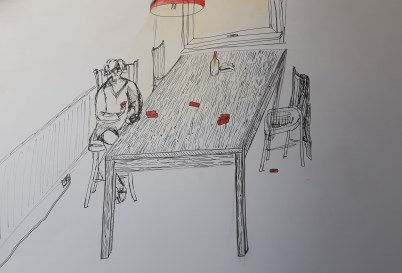 compositions with different media as a start.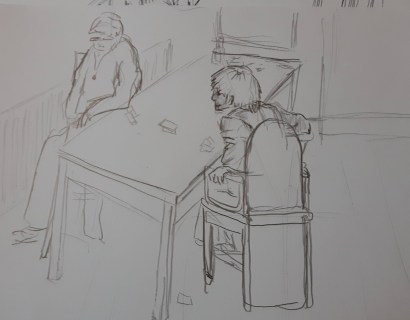
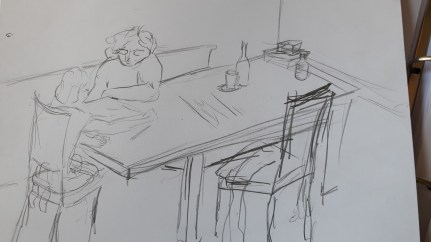
I liked the idea of the figure just getting up from a chair so I made a longer study with colours.
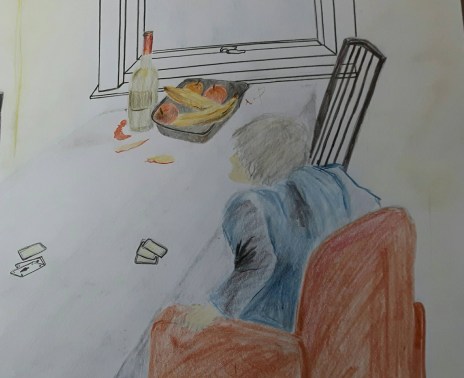
I didn’t really like it. Then one evening one of the players hurried upstairs during the game and there was this empty chair with a jumper negligently hanging on it (he dropped a card on the floor when I made the very first sketches and since then I always draw one card on the floor, too) I realized that I do not need the presence of the other cardplayer. I just need to know that he’ll be back soon. I was gonna use lots and lots of colours. Recently I read a book Interaction of Color from Josef Albers which was a really useful tool for this adventure. I played around with colours on the man-made and natural objects I originally wanted to include in my picture.


There are some sketches of the seated figure


I tried to draw the head in a different style to see which one would be the most interesting


Finally I started drawing using HB pencil
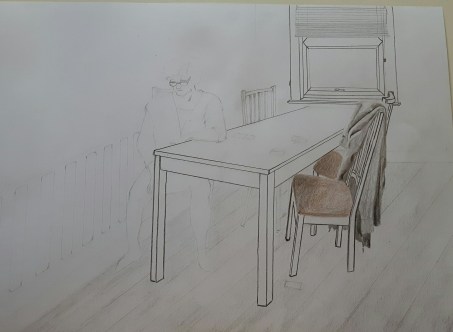
I decided that I would draw with pencils only because -though I like the crispiness of ink drawings – blending with 4B-8B pencils and Inktense would give the soothing impression I wanted. For the same reason, I reduced the variety of colours so my final drawing was made with limited palette. The natural light came from the window mixed with less artificial light from the lamp.
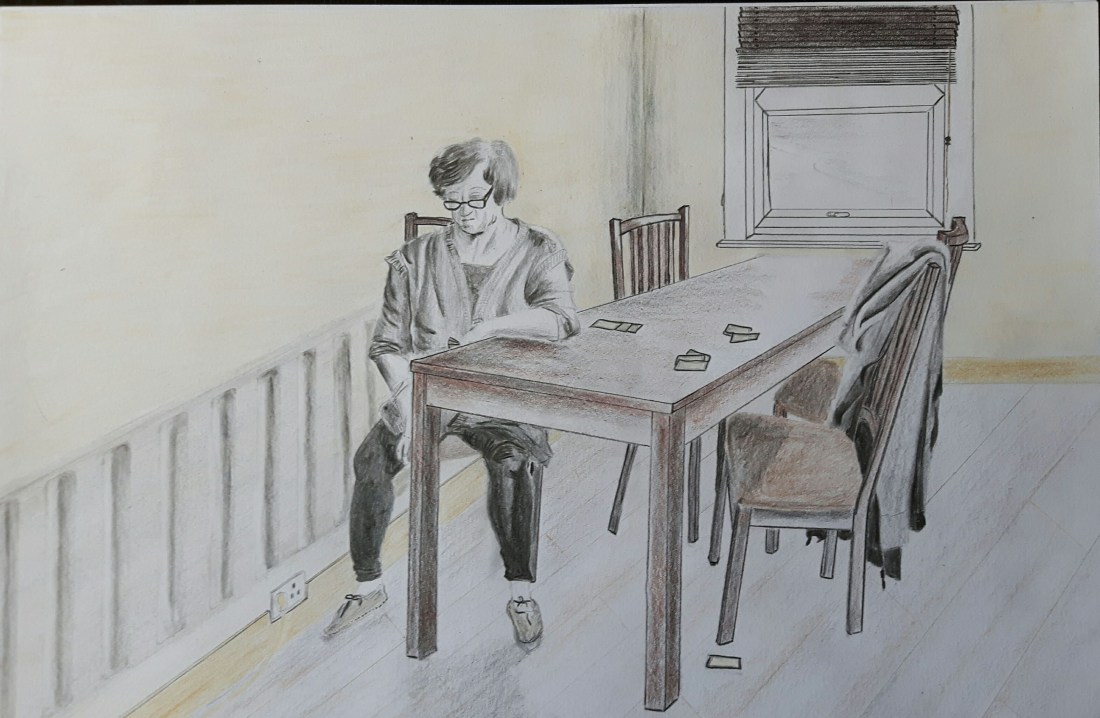
The final drawing
ARTIST’S STATEMENT
I chose my subject because of my deep interest in depicting the human body and the fact that I had a chance to watch cardplayers for a relatively long time and found the subject really promising. At the very beginning, I did not really have any other real direction so I checked some related drawings/paintings online and in the library. I tried to work with live model as much as I could because the finer tones seemed to fade away on the photos. The idea of using ink dropped quickly when I realized I wanted to include reflective surfaces and some soft material thrown on the chair. Though I left the bottle out of the drawing at the end, pencils were still a much better choice because of the smooth blending. I used brownish shades – bark and baked earth colour, the latter is slightly reddish – with yellows. I left both the clothes – the jumper on the chair and the baggy top on the figure – with no colours as I noticed earlier too many different shades could look overworked and exhausting at the same time if a small format is used and my final work is on A3 size that is relatively small. It really helped me to work on this part to have a look back to Part 4. Project 1 Fabric and form exercises where I had to identify the light and dark areas.
When I planned the perspective of the table I was inspired by Felix Vallotton The Poker Game, and the Chairs and Table by Sophie Walraven. I also liked Cezanne Card players series including 5 paintings with different sizes and different numbers of players especially one of the sketches that were made in preparation for the final paintings. This particular one – ‘Study for Card Players – is graphite on paper emphasized with small colour detail in watercolour. I was not happy with some of my poster-like colourful images so I decided that I choose not too many colours, possibly a limited palette.
The other painting that really moved me in the right direction was Hugo Oehmichen – The card game. This picture tells me a story about the mother and daughter seem to be in happy league with each other with a standing figure behind who fills the whole picture with warmth. I wanted to express something similarly obvious feeling with the figure’s posture and facial expression, I tried to depict this little bit of other-worldly gaze on the face that I saw on the painting ‘Young man at the Table’ by Mihaly Munkacsy. Probably I could have worked more on the contrast on one side someone waiting patiently and on the other side, someone just left quickly, dropped a card on the floor without being noticed… Whilst this work may not be very good technically I learned from it a lot to follow my instincts and be more experimental.
Demonstration of technical and visual skills
With this assignment, I tried to work with large gestures but also depicting subtle details carefully when it was needed. I started this course only with graphite pencils and even though this drawing was also done with pencils, I explored line and tonal values on this journey and slowly introduced colours, too.
Quality of outcome
This assignment was partly successful. I liked the message in it but I could have emphasized more because it looks a bit ’empty’.
Demonstration of creativity
I could have worked more on tones especially with the shadows, also I left out the still life part on the table and it should have been there. However, I found the composition interesting and expressive.
Context reflection
I enjoy more the research now than I enjoyed in the past. I realized it did help me to find more interesting compositions and pushed me to dare and explore rather than staying in my comfort zone. At the beginning of this course I thought it was a bit of waste of time, now it is a useful tool.
Reflection on Drawing Skills 1. course
Assignment 1-5.
At the very beginning, I was really excited to start something new. I had the passion but had only basic drawing skills, not much experience and never practised regularly. My visual skills, knowledge of the medium, techniques needed great improvement. At that time I had a very “shy” approach, using only graphite pencils – occasionally charcoal – and my drawing style was very tight – due to the fear of failure. I did not enjoy the first couple of exercises wholeheartedly because my sketches were way too far from my expectations. The first valuable lesson was from this course that I had to be in less control and I also had to introduce the regular practice into my everyday life if I wanted any improvement. Slowly but surely it happened so even though my first assignment was done with a pencil and still looked tight I felt I had the ability to improve.
In part two, there was an introduction to colours. Apart from the liquid medium, I tried a very wide range of colouring tools. I found to work with sepia pastel is very expressive and I really enjoyed Inktense pencils because of their powerful and bold colours. I was determined to learn more about how colours related to each other, how you can reach certain effects with different tonal values, blending and generally about the relativity of colour, harmony, and intensity. Later on, I used many times the ‘Interaction of Color’ from Josef Albers suggested by my tutor. Still, my favourite exercise was the still life using line, because of the fresh and clean image done with black ink. Part Three Expanse was the most troublesome, though I enjoyed learning about different perspectives. I think the reason for not being drawn particularly to landscape is that I tend to draw every small detail (leaves, pebbles) instead of suggesting their presence so it was overwhelming sometimes and seemed an impossible task to finish. However, those exercises did loosen me up noticeably. Part 4 made an improvement in my observational skills especially the drawing exercises in three dimension. I really enjoyed every part of it but clearly, I had to (and still have to) work on proportions and tones a lot. My personal project in part 5. was a really good experience and reflected my journey through this course.
In the beginning, I was not really keen on the research part but the more I did the more I enjoyed to the point when I spent long hours online just wandering from painter to painter through centuries and art movements. Overall I learned a lot through this course, I am happy with the improvement I made and looking forward to the next chapter.

 LaraDraw